Royal Hospital of Granada - History, What to See, Hours, and Practical Information
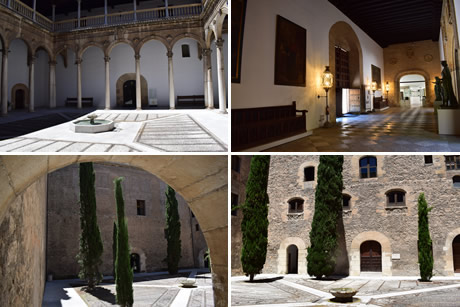
The Royal Hospital of Granada was founded at the beginning of the 16th century by the Catholic Monarchs, Isabel and Fernando, after the conquest of Granada. It was created to care for the sick, the poor, and people without resources.
Enjoy a special day at the Alhambra with a guided tour
 Alhambra and Nasrid Palaces: discover the wonders of the Alhambra with this all-inclusive tour: the Nasrid Palaces, the Generalife, the Alcazaba, and more.
 Alhambra + Albaicín + Sacromonte: a perfect combination of a guided tour of the Alhambra in the morning and a guided tour of the Albaicin and Sacromonte in the afternoon.
The construction of the Royal Hospital of Granada was part of the Catholic Monarchs' plan to transform the city into a modern urban center by eradicating its Islamic influence.
To achieve this goal, they planned a major transformation of the city, beginning with the construction of three important buildings: the Monastery of Santa Isabel la Real, located in the heart of Albaicín; the Royal Chapel, situated in the medina; and the Royal Hospital, built outside the city walls.
Five Artistic Styles in One Building
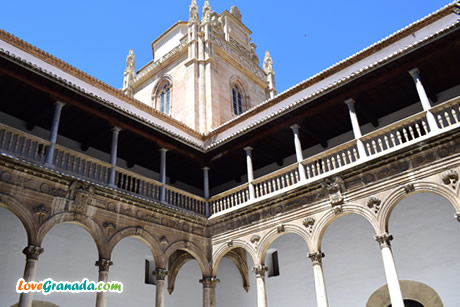
- Due to the long period of time that elapsed during its construction, the Royal Hospital of Granada reflects various artistic styles spanning from the 15th to the 18th century: Gothic (seen in the dome), Mudejar (present in the roofs of the naves), Plateresque (evident in the windows), Renaissance (observed in the courtyards), and Baroque (reflected in the façade).
Why is the Royal Hospital of Granada important?
The Royal Hospital holds significant importance in the history of the city for several reasons: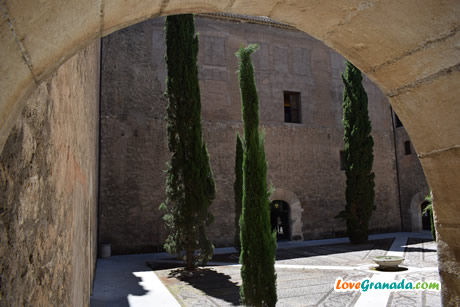
- In the Royal Hospital, for the first time in the history of Spain, the monarchy took responsibility for the welfare of the poor and the sick. As a result, the State undertook the responsibility for maintaining hygiene in the medieval city.
- With the arrival of patients from other hospitals, it transformed into a general hospital, a completely novel concept. The Royal Hospital provided care for all types of patients, including those with mental health conditions.
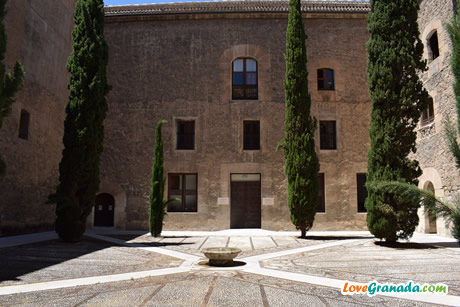
- It represents a new model of hospital, built specifically for accommodating the sick, independent of a monastery or religious establishment, and following the Filarete model: with open-air courtyards that help ventilate the rooms and filling them with light.
The History and Evolution of the Royal Hospital of Granada
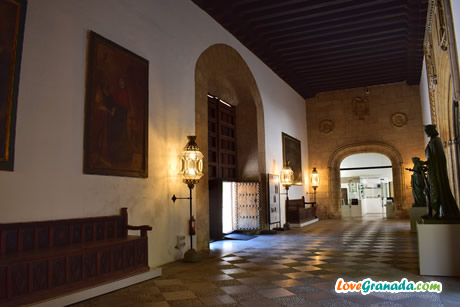 The Royal Hospital of Granada was founded by the Catholic Monarchs shortly after the conquest of Granada in 1504.
It was constructed on the outskirts of the city, near the Puerta Elvira,
on the site of a former large Muslim cemetery.
The Royal Hospital of Granada was founded by the Catholic Monarchs shortly after the conquest of Granada in 1504.
It was constructed on the outskirts of the city, near the Puerta Elvira,
on the site of a former large Muslim cemetery.
The Royal Hospital of Granada was built by the great artists and architects of the time.
The layout was designed by Enrique Egas, who was also working on the Royal Chapel.
 Diego de Siloé and Pedro Machuca
contributed to the project as well. Egas followed the model used by Filarete in the Hospital Mayor of Milan.
Diego de Siloé and Pedro Machuca
contributed to the project as well. Egas followed the model used by Filarete in the Hospital Mayor of Milan.
Construction began in 1511 in the Gothic style. By 1516, only the first floor had been completed, when King Ferdinand the Catholic passed away, causing the project to be halted.
It did not begin operating until 1525, when patients from the Maristan, primarily the mentally ill and the needy, were transferred there.
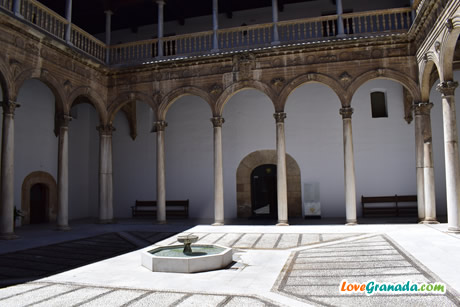 In 1526, his grandson, Emperor Charles V, resumed construction, with master stonemason Juan García de Pradas and
carpenter Juan de Plasencia in charge. This marked a shift toward the Renaissance style, with a notable increase in Renaissance artistic expression.
In 1526, his grandson, Emperor Charles V, resumed construction, with master stonemason Juan García de Pradas and
carpenter Juan de Plasencia in charge. This marked a shift toward the Renaissance style, with a notable increase in Renaissance artistic expression.
By 1527, the second floor of the building was completed. However, the decoration of the courtyards remained unfinished, and it was not until the end of the century that this work was completed.
The façade was not built until 1640, designed by Alonso de Mena.
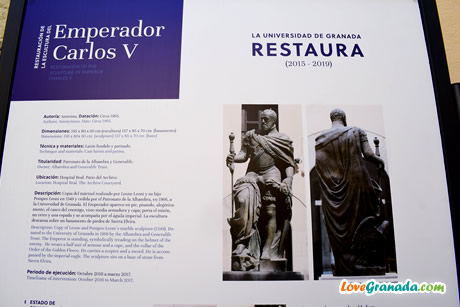 The different artistic styles combine harmoniously in this marvelous monument, with no interruptions. Even the decoration of the façade,
dating from the 17th century, includes the Catholic Monarchs as the founders of the Royal Hospital.
The different artistic styles combine harmoniously in this marvelous monument, with no interruptions. Even the decoration of the façade,
dating from the 17th century, includes the Catholic Monarchs as the founders of the Royal Hospital.
In 1961, the hospital was purchased by the Ministry of Education, which found it in very poor condition and began its restoration. In 1971, it became the property of the University of Granada (UGR), which ultimately decided to convert it into its headquarters by 1980.
What to See in the Royal Hospital of Granada
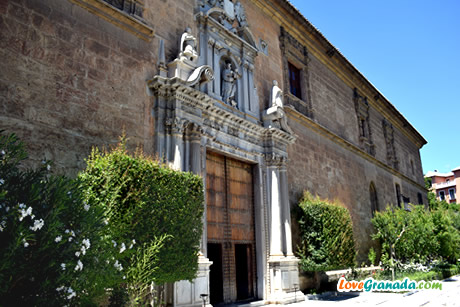 Royal Hospital consists of two naves in the form of a cross with equal arms and four symmetrical courtyards at the corners.
In the crossing, where the naves meet, there is a dome adorned with pyramids and pointed parapets. This area is divided into two floors, which was quite uncommon for the time.
The façade, constructed from Elvira stone, dates back to 1632 and represents Granada's earliest example of Baroque style.
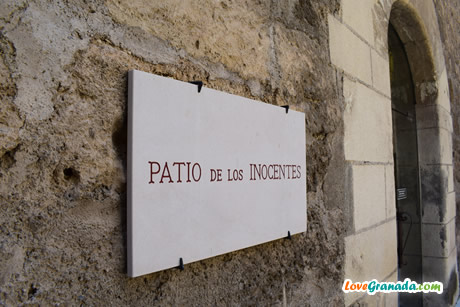 On the façade, four richly decorated Plateresque windows display the initials and emblems of the founding kings. This work is attributed to Juan Maron.
The lintel is supported by four Corinthian columns, above which rises a second level with a central niche containing a statue of the Virgin.
On either side, white marble sculptures of the Catholic Monarchs in prayer adorn the structure. These sculptures are attributed to Alonso de Mena.
Visiting Hours and Prices of the of the Royal Hospital
At present, the General University Library, the Rectorate, and the General Services of the University are situated here. You can see all areas, including the General University Library, the courtyards, and the gardens in 1.5 hours.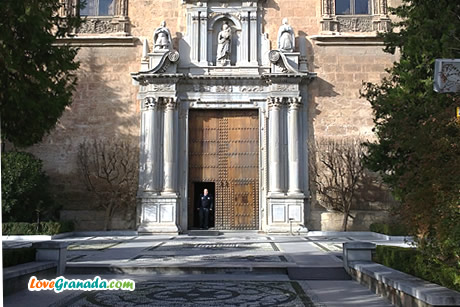
Visiting Hours of the Royal Hospital
You can visit the Royal Hospital from Monday to Friday, from 9:00 am to 9:00 pm; it does not close at noon.
Additionally, it is advisable to visit the General University Library, which is open until 8:30 pm.
Royal Hospital is closed on Saturdays and Sundays.
Admission fee
Admission to the Royal Hospital is free. For consultations you can call 958 243 060.
How to get there and where to park near the Royal Hospital?
 The Royal Hospital is located near the Triunfo Gardens.
Address: Avenida del Hospicio, 1, 18012, Granada.
How to get to the Royal Hospital by city bus?
You can get to the Royal Hospital of Granada on line C31 or C32, the stop is Avda. del Hospicio - Hospital Real.It is the closest stop, but you can also get there by any of these Granada city bus lines: 4, 11, 21, 33, N1, N3, N5, N9, getting off at the stop Avda. Constitución 2 - Triunfo.
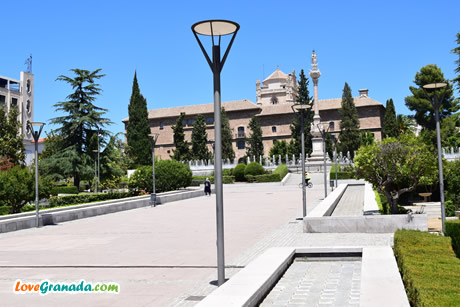 The Royal Hospital is 2 minutes away from this stop.
Also, on lines 8, N8 y C34, Ancha de Capuchinos - Jardines del Triunfo stop is just 1 minute away from the hospital.
Where to park near the Royal Hospital?
The closest parking is Parking Triunfo: Avda. de la Constitución, 20, Granada. It is a bit expensive, 2.85 euros per hour.Given that the visit to the Royal Hospital lasts 1.5 hours, parking there might be a good idea.
What to See Around the Royal Hospital?
 There are many interesting
places and
monuments close to the Royal Hospital:
There are many interesting
places and
monuments close to the Royal Hospital:
- Triunfo: 13th century gardens.
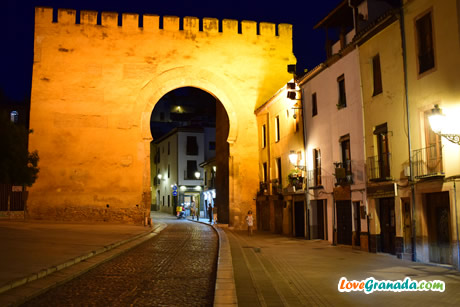
- Puerta Elvira: the oldest entrance gate of Granada.
- Gran Vía: the main street of Granada.
- Fray Leopoldo: nearby, there is a crypt and museum dedicated to the memory of a much-loved Capuchin friar who lived in Granada.
Page Updated: Jul 31, 2026
Was this useful? Been to these sights? Share your thoughts!
© Copyright •
LoveGranada.com • Any use of the content, including copying of it in whole or in part is prohibited.
You Might Also Be Interested In
Follow us on our social networks


If you find this information useful, please share it


Opinions about Royal Hospital of Granada
I recommend visiting the Royal Hospital

Although I was born at the Inmaculada Hospital, next to the Genil River, I am officially registered in a town in Jaén called Alcalá la Real, which borders the province of Granada.
From my childhood visits, I remember with great impression and amazement the colorful fountain. Later, during my university years, I got to know the area better, as it was on the route between my home and the Cartuja campus.
Soon after, I discovered the Royal Hospital, where I used its old library as a study room, and the church of Fray Leopoldo de Alpandeire. Now I have just learned that there was an Arab cemetery and a bullring in this area.
Two days ago, I walked along Calle Ancha de Capuchinos, bought something from the bakery called “La Gracia de Dios,” and sat in the shade for a while on one of the benches. I was very comfortable there because, being on a slope, the square offers beautiful views.
I ended my visit to the area by drinking water from the fountain at the corner of Gran Vía street, next to the wall of the Normal Schools building.
I recommend visiting the Royal Hospital and, from there, continuing on to the Elvira Arch, the San Juan de Dios Hospital, and, in short, all of Granada, while we are still able to enjoy it.
Worth a visit

A place with a university atmosphere and has pretty buildings and gardens.You can also visit galleries, exhibitions, a cloister, a library, and four interior courtyards.
My favorite parts are the Marble courtyard, the Chapel, and its impressive facade. And don't miss the Arch of Elvira and the Triunfo Gardens nearby.
Worth visiting
Since a visit to the Royal Hospital is not usually part of most visitors’ itineraries, I encourage everyone to spend at least an hour there, enjoy its architecture, and learn a little about its interesting history. You can also take the opportunity to visit one of the painting or sculpture exhibitions that are often held there.
See More Reviews
Worth a visit
Granada has many places to visit. If you are only in the city for one day, this is probably not the main attraction you should see. However, if you plan to stay for several days, it is worth a visit.
If you like libraries, history, and gardens, this is the place for you. It is a peaceful spot, not as crowded as many other places in Granada. It has a beautiful façade, lovely gardens, charming interior courtyards, and, of course, a magnificent library.
Relevant Information

The station, ski lessons, ski pass, parking, equipment rental, where to eat, how to get there and where to sleep.
Where and how to buy tickets for the Alhambra and where to collect them, what to do if tickets are sold out.

